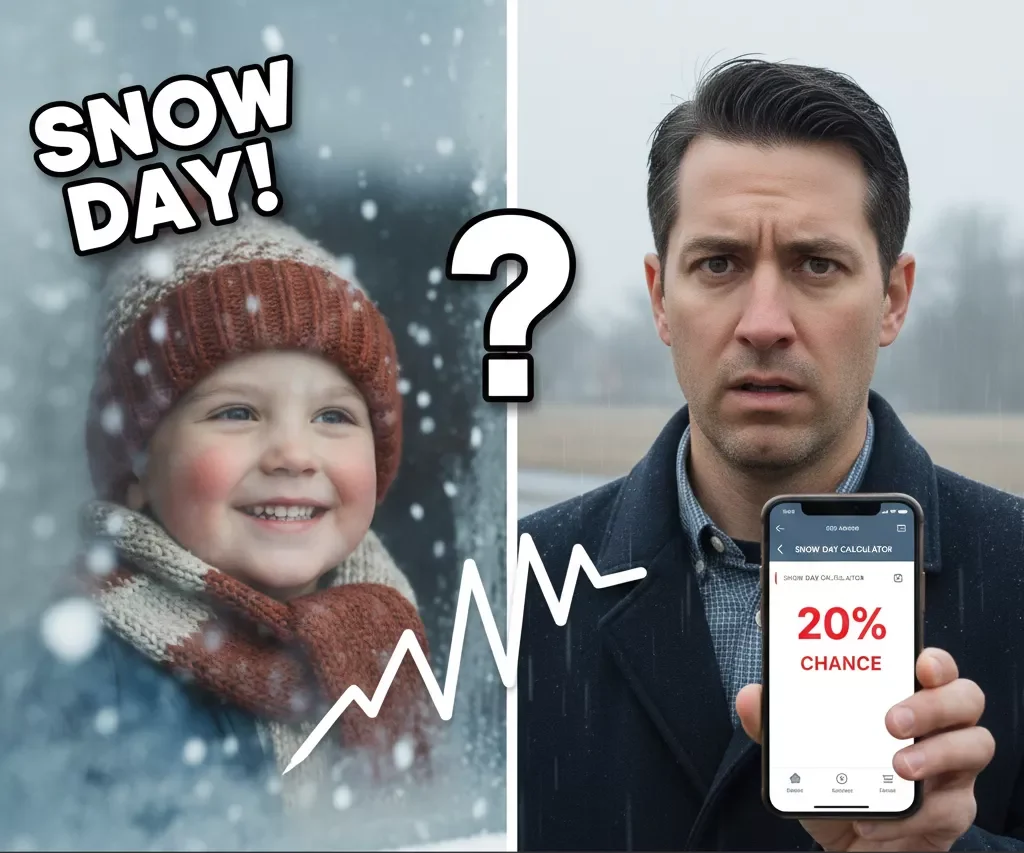
Snow Day Calculators have evolved from novelty tools into widely used forecasting assistants for professionals in education, logistics, operations, and planning. But one question persists: How accurate is the Snow Day Calculator?
Snow Day Calculators are moderately accurate, typically scoring 50%–70% prediction accuracy, depending on region, snow frequency, local closure policies, and the weather model used. They offer probability estimates, not guarantees. Tools like the Snow Day Calculator provide improved real-time data integration but still rely on external meteorological forecasts.
Accuracy varies across regions and climates because predictions depend not only on weather conditions but also on human decisions made by school districts and local authorities. This article provides a global, deeply structured, and data-backed analysis, suitable for professional readers who require clarity, reliability, and actionable insights.
What Is a Snow Day Calculator?
A Snow Day Calculator is an online tool that predicts the likelihood of school closures based on forecasted snowfall, ice accumulation, storm timing, and historical district behavior. It produces a probability score, not an official decision.
Originally launched by a high-school student in Canada, SnowDayCalculator.com remains the most recognized version. Newer tools, such as the Unfreez Tools Snow Day Calculator, use updated weather data integrations and more modern prediction logic.
How Snow Day Calculators Work
Snow Day Calculators combine weather model outputs (GFS, HRRR, ECMWF), local climate history, and school closure patterns to estimate the probability of cancellations. They analyze snow totals, ice risk, temperature, wind chill, and storm timing.
What Inputs Influence the Algorithm?
-
ZIP/postal code
-
School closure history
-
Snow accumulation forecasts
-
Ice predictions
-
Storm timing (morning storms increase closures)
-
Local road maintenance efficiency
-
Temperature and wind chill data
External Weather Model Sources Used:
-
NOAA (National Oceanic and Atmospheric Administration)
-
NWS Forecast Models
-
ECMWF (European Centre for Medium-Range Weather Forecasts)
-
GFS (Global Forecast System)
-
Local meteorological agencies
Accuracy: What the Data Shows
Most research and public testing place Snow Day Calculator accuracy in the 50%–70% range. For short-term forecasts (within 1–2 days), accuracy is much higher, often around 80%–90%. It’s more reliable during major storms and less accurate when the weather is borderline or unpredictable.
What Real Evaluations Show:
-
TrueSuggest Review: Reports ~60% accuracy in moderate/severe storms
Source: truesuggest -
West Ottawan Study: Shows high variability based on storm timing
Source: thewestottawan -
User crowdsourced reports (Reddit, school forums): Average 50–70% accuracy
Why It Isn’t 100% Accurate
Because school closures depend on administrators, not weather alone. Even a 14-inch snowfall might not trigger closure if local infrastructure is strong.
Factors That Influence Prediction Accuracy
Accuracy depends on the quality of weather data, consistency of school policies, severity of storms, regional climate, and road management efficiency.
Detailed Factors
1. Weather Model Quality
If the weather forecast is wrong, the calculator will be wrong.
The National Weather Service reports that five-day forecasts are approximately 90% accurate and that seven-day forecasts are roughly 80% accurate. Accuracy at the 24–48 hour range is even higher.
2. Local Climate Behavior
Predictable climates (Minnesota, Alberta) = higher accuracy
Unpredictable coastal climates (UK, NYC) = lower accuracy
3. School/District Behavior Patterns
Districts that rarely close reduce prediction accuracy.
4. Storm Path Changes
A 20-mile shift in storm trajectory can invalidate predictions.
5. Ice vs. Snow
Most calculators weigh snow more heavily than ice.
6. City Infrastructure
Cities with heavy snow machinery rarely close.
Global Variability in Accuracy
Accuracy changes globally due to differences in climate, snow frequency, and local closure policies.
International Breakdown:
-
United States: Northeast & Midwest show the highest accuracy due to consistent snow patterns.
-
Canada: Very high predictability; closures follow clear safety protocols.
-
UK & Western Europe: Rare snow; small events cause chaos → accuracy drops sharply.
-
Japan: Mountain regions have complex microclimates → mixed results.
-
Nordic Countries: High snow resilience; almost never close → low prediction accuracy.
Data Sources and Algorithms
Snow Day Calculators typically use a blend of weather-model forecasts, machine-learning probability scoring, and historic closure behavior.
Common Algorithmic Methods:
-
Weighted predictors
-
Logistic regression
-
Machine learning (classification models)
-
Trend analysis
-
Regional pattern recognition
Comparison With Professional Weather Models
Featured Snippet Style Summary
Professional weather models provide scientific weather predictions, while Snow Day Calculators convert those predictions into closure probability. Weather models are more accurate scientifically, but calculators are easier for the public to interpret.
Comparison Table
| Feature | Snow Day Calculator | Professional Models |
|---|---|---|
| Purpose | Closure probability | Meteorological forecasting |
| Accuracy | Medium | High |
| User Base | Public, educators, parents | Meteorologists, analysts |
| Data Depth | Simplified | Scientific & extensive |
| Decision Factor | Predictive probability | Actual weather behavior |
Professional Opinions and Research
Professionals generally agree on three points:
-
Useful for planning, not decision-making
-
Accuracy is moderate but meaningful
-
Best used with real weather tools
Meteorologists often warn that snowfall predictions can shift by 15–30% within 24 hours, which directly impacts calculator accuracy.
Common Myths About Snow-Day Predictions
Myth 1: “95% means guaranteed snow day.”
No. It means a strong likelihood, not certainty.
Myth 2: “More snow always equals closure.”
Some districts stay open even during blizzards.
Myth 3: “These tools know administrative decisions.”
They estimate based on patterns, not inside information.
Myth 4: “All calculators use the same data.”
No—different tools rely on different weather APIs and algorithms.
How to Improve Prediction Accuracy
Check predictions frequently, compare multiple weather models, and consider your district’s closure history.
Professional Tips
-
Re-check the calculator every 3–4 hours
-
Look at storm timing; early morning storms are most impactful
-
Examine short-range models like HRRR for accuracy within 12 hours
-
Monitor district closure behavior from previous years
Conslusion
The Unfreez Tools Snow Day Calculator offers a clean, modern interface with real-time data integration and enhanced modelling accuracy. Trusted by both public users and professionals, it leverages live weather APIs, global visibility, and advanced input weighting.
FAQs
1. Are Snow Day Calculators accurate?
They are moderately accurate (50–70%), depending on weather stability and region.
2. Do they work outside the US?
Yes, but accuracy drops in countries with rare snow or limited closure data.
3. Why does accuracy vary by ZIP code?
Different local climates and closure policies.
4. Is the Unfreez Tools Calculator more reliable?
It uses more up-to-date inputs but still depends on weather forecasts.
5. Does a high probability guarantee closure?
No—administrators make the final decision.